On a recent tour, the camera that we had used for the last ten years, to capture images of our ECO-Tours, was stolen. We are seeking funds to replace it. If one of our supporters has a decent quality digital camera to donate, that would be even better, but for now we are camera-less and are seeking help to remedy this situation. Luckily, there were no photos on the memory card, but the card was a high volume one and the pictures that we were able to take with it over the years are invaluable, so the sooner we can afford to replace it the better.
Saturday, July 27, 2013
Sunday, July 21, 2013
Toward Encouraging Healthy Leadership
Parenting has the power to shape the future. Having been raised as and trained to be a teacher, I have had a unique opportunity to be exposed to reams of data about raising children to be all that they can be, as well as what poses the greatest threat to their intellectual capacity and emotional health. Having raised three exemplary individuals who are making positive contributions to their environment and community, I feel especially qualified to guide others on their own parenting experience. Please feel free to question me further on any of these issues, I am always open to integrating new ideas and information, honing my own parenting style and my own teaching techniques. Parenting is the most important job on the planet and has the ability to shape future generations across the ages.
We must teach the next generation, for their
good as well as our own. The future of our entire culture rests on the
foundational knowledge passed on to the next generations. Negative risk taking
should be discouraged, such as violence and thrill seeking, smoking, alcohol
abuse, addictive and dangerous drugs, etc. There will be times that young
people will need our help, affirmation or protection. However, all children are
going to want to spread their wings. They have to try things on their own. Adults
must let them. Let these few tips guide you when developing your unique parenting
style.
Help
them learn to take calculated risks.
Talk ideas over with them, point out possible outcomes and help prepare them
for what they may find. Then, let them do it. Your primary job is to prepare
your child for how the world really works, making sure that they are still alive
when they finally fly to coop.
Discuss choices. Prepare them for possibilities and teach them how to both,
win and lose, gracefully. Remind them that they may not get all they want and encourage
them to face the consequences of their decisions.
Share stories of your own “risky” experiences. Help interpret them. This is one of the hardest pieces of
parenting advice for most people. Sheltering our young from our own learning
experience assures that they will suffer through making many of the same mistakes
we had to. Because we’re not the only influence on our children, we must be the
best influence.
Instead of tangible rewards, just
spend time together. Be careful not to teach them that emotions can
be covered up by a trip to the mall or burying yourself in work. Children are
often smart enough to realize that they don’t want to grow up to participate in
their parent’s world, but if they learn from us that there is no other choice,
it can lead to very dangerous consequences, depression, mal-adaptive and
self-abusive behaviors.
Encourage positive risk taking. It may require encouragement, but get them used to trying
new things in safe ways and pursuing as many opportunities as they can. Help
them understand that they will never know if they like something unless they
try it.
Don’t let guilt get in the way. Your number one job is not to placate your own feelings of
guilt or inadequacy by giving your children everything. Never use guilt as a
tool to exact compliance either. The surest way to raise a damaged child is to
let them see you trying to overcome your own guilty conscience through them, or
by instilling these toxic emotions in them.
Do not praise or reward the basics. If any relationship is based on constant praise or
material rewards, we experience neither intrinsic motivation nor unconditional
love. Certain activities are necessary for health, survival and living with
others. Basic levels of functioning are not to be celebrated or praised excessively;
it is just what we all must do. Taking on additional responsibilities or going
over and above what is expected can be noteworthy, but some things in life are
just that. The reward is that others do those same things.
Acknowledge intelligent risk-taking
and hard work. Help children to see the advantage
of both. Be a living example, showing them that stepping out of our comfort
zone usually pays off. Communicating our own process and encouraging them to
take on both freedoms and the responsibility that comes with it allows them to
flourish.
Your child does not have to love you
every minute. In fact, if you are doing your job well, occasionally they won’t.
We all must learn to get over disappointment and failure but we don’t being
spoiled. Let your children fail, let them fall, and let them fight for what
they really value. Treating our kids as if
they are fragile creates fragile adults. We only have a short time to prepare
them for the world that awaits them. Our world needs resilient adults not
fragile ones.
Saturday, July 20, 2013
How Do You See The World?

We all have "maps" in our heads. The lies that we tell ourselves with maps involve lines, regional differences, perceptual limitations, judgements, assumptions and they are often based on what we have been told, how we feel and what we understand about the world around us. No one is immune to the lies that maps tell. In an attempt to represent a sphere in two dimensions, map makers take liberties with the images that we often see representing the planet Earth. For many centuries, humans have gotten around the planet with schematic diagrams. It could be argued that none of has ever had a clear picture of the world we inhabit. Even the photograph or the blue marble that astronauts sent back from space, floating in a black void, even though it has changed the way we see our home planet, is a generalization.
By drawing maps, even of tiny parts of our planet, we are digesting a nearly infinite number of data points and including a miniscule fraction of ones that help us make sense of the whole. I have seen maps that have helped me on my travels that show tiny lines representing fifty foot wide roads as a line, but if you drew that line to scale on the planet, it would be miles across.I have seen representations of the shoreline of a multitude of lakes that eliminate many of my favorite peninsulas and points as well as flooding many of my favorite places to camp along the shore. Even the weather maps that I see nearly daily tell me things that I know not to be true, even the most accurate doppler radar shows shadows and echoes that are not really weather, but the illusion of weather. discreet data points cannot show patterns, qualities of energy that our devices are not calibrated to, smells or the hospitality index of certain places. I have seen maps of energy centers. In fact, I have drawn them, but the crystal clear vision of the world that we think maps can give us are a vague representation of the places we live our lives.
Like the stick figures that children draw, our maps can only be schematic and without putting ourselves into the environment around us, we may never know where we actually are in relation to Mother Earth. I have met kayakers who told me that they had to leave Wisconsin because they knew all the rivers too well. It was no longer interesting for them to shoot the rapids that they had come to know. I still contend that they had not actually "seen" a single one. From their point of view, moving with the current, their intimate map of each river only had the good put ins, deep water, quiet water, drop offs, the giant boulders, dangerous rocks, the haystacks and the long tongues of flow in them. Had they only dipped a few worms or a few flies into the stream, their map may have contained musky, trout or salmon, pike, gar and carp.
I am always interested to learn about the planet we call home. I am open to the ways in which each of us sees the world, but the more I learn about the places that we inhabit, as well as the ones we have left wild, I understand evermore exquisitely that the maps we carry in our minds are uniquely our own. ECO-Tours are designed to help us realize our limited perception and develop our ability to imagine what our planet could become if we just paid it a little more attention.
Monday, July 15, 2013
Real Life Versus Digi Life
In the digital realm, I have been pulling back. The many hundreds of people that I have guided through the twists and turns of recycling, plastics manufacture, how to live better on less, the corporate welfare subsidies and the inner workings of our not-for-profit organization have had to take a back seat to real life events, pressing needs and the planting of another season of trees. Since July first, our tree planting has been shut down because of the "normally" hot dry weather that is typical for our part of the world. In our first few years, when we were still learning the basics and had stronger backs, we would hand carry thousands of gallons of water up hill, along trails and into the woods to water young seedlings. Now, we rest during the hottest, driest part of the year and focus more on spring and fall planting. We do carry an occasional drink to newer seedlings, but not nearly as much as we did in the old days. One of the things I like best about living in ways that honor and respect the cycles of the seasons is that when it is time to work hard at specific tasks, not only are conditions "right" for human comfort but the results of our activities seem to be more efficient.
This year, we changed our focus from outside the fence to inside the fence around the first of July. Our gardens have never looked better and the trees we planted in spring seem to be happy and adjusting well to their new homes. This year on our tiny 20X50 foot (6X15.25 meter) garden, we will be harvesting hundreds of dollars worth of produce. As usual, we are experimenting with several new techniques and trying a few new plants, but the vast majority of what we are growing has become vital to our diet and as familiar as the smell of rich life-giving humus. The past month has allowed us to get things recycled, thrown out, burned or put away, the garage has never been as organized as it is right now and we have three compost bins, one for vegetables and two for trees.
Seed harvest time is nearly upon us and we watch expectantly as the black walnuts, acorns and other nuts ripen in the sun. This year we are asking our supporters to donate what they can so that we can purchase a few nut collectors.We rarely purchase equipment, but when we do, it is used to maximize our effectiveness and this is a huge time saver. Earlier this spring, we requested donations for a broadfork or two and because they are so important to rehabilitation of compacted and lifeless soils, we are still asking for help with their purchase. I have seen compacted, lifeless, hard clay turned to friable, rich living soil by just one pass with the broadfork and a liberal application of compost. It may have taken a few years to build up the ground again, but the primary mover in the process is the air and moisture that is allowed into the soil that makes life possible. Last season, we collected and distributed nearly a million seeds form just one species and this year we hope to do it again in far less time. Getting those tree seeds into the right places is the hardest part of our work and without the long handled dibbers that we use to plant them, our task would be virtually impossible. Unlike the squirrels, we are far too tall to effectively plant seeds without a tool.
I trust that our readers will accommodate our schedule as it is determined by the weather, the seasons and doing the right things at the right times. a favorite saying of mine is from the realm of sailing but it applies to ECO-Tours as well. Fair weather sailors miss 90% of the fun. similarly, if we wait for comfortably cool and beautifully sunny days, we would only get a few hundred trees planted at best, maybe only a few dozen if we wanted to buy and plant big trees. Our focus on building soil, growing seedlings in the best possible habitat and caring for them once they have been put in has allowed us to increase our effectiveness exponentially.
What we are working toward now is growing our digital effectiveness as well. Over twenty years of tree planting we have learned a great deal about the who what where and when regarding the process of growing forests. The hundreds of acres that have been transformed through our ECO-Tours are well on the way to what foresters recognize as mature woods. In our area, it can take hundreds of years from empty field to full forest, but our techniques can accelerate this process greatly. One measure of mature forests in our geographic location is that they are home to about 300 trees per acre (.4 hectare) Our tours frequently plant this many trees in a single day, but we usually spread them out over a much larger area, planting a large number of small clusters of trees, rather than long rows of one or two species. Getting specific plants in areas that have the best chance of success requires a nearly microscopic view of huge areas and in some ways this process is mimicked by the digi-realm. We want to develop the best ECO-Tour for each of our readers, each of our guests and ones that have the best chance of bearing fruit over the long haul.
If you have ideas about growing our effectiveness in this realm, or if you have money to donate to our reforestation, get in touch with us here or by e-mail at: tnsaladino42@hotmail.com. Donate through Paypal by using our e-mail address as the account number. If you are coming to the Western Lake Michigan Watershed, or the Southern Lake Superior Watershed, let us know your itinerary and we will design an ECO-Tour specifically for you! There are forces at work that want to continue altering the landscape in terrible ways, making places that look like the top image look like the bottom image.

ECO-Tours of Wisconsin inc. is dedicated to finding landscapes that look like the bottom image and turning them back into something more akin to the top image. With a little help from a lot of people, we have been able to transform hundreds of acres, now we want to increase our reach and effectiveness further. please do what you can to help.
Monday, June 17, 2013
This Post By Tenney Naumer Shows What We Are Up Against
Saturday, June 15, 2013
TransCanada Is Secretly Briefing Police About Keystone XL Protests and Urging Terrorism Prosecutions
by June 12, 2013
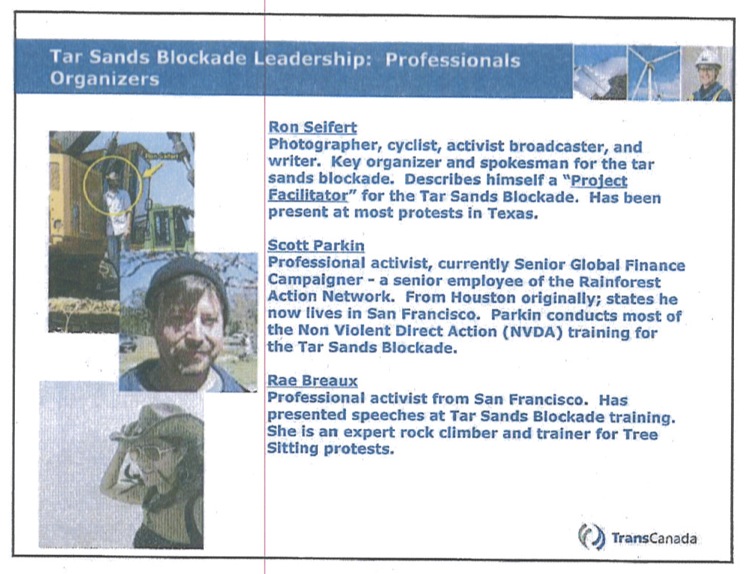
New documents show that TransCanada, the corporation behind the $5.3 billion Keystone XL oil pipeline, has been briefing police about non-violent protesters and urging prosecutors to consider them “terrorists.”
Environmentalists have waged a diverse campaign against the 2,000-mile pipeline that has included civil disobedience at the White House, tree sits and blockades, and a new lawsuit by the Sierra Club saying the U.S. State Department’s environmental review of the Keystone XL is “plagued by conflicts of interest.”
The tactics are working. In response, TransCanada is filing lawsuits across the country in hopes of deterring opposition; in Oklahoma, they recently filed a restraining order against protesters.
New documents show that TransCanada is also working behind the scenes with local police, providing cops with names and photographs of dozens of activists, warning of non-violent tactics, and urging terrorism prosecutions.
A TransCanada PowerPoint presentation was obtained by Bold Nebraska through the Freedom of Information Act. The briefing is dated December 11, 2012, and offers a rare look at how the energy industry giant is trying to silence its opposition.
Activist Dossiers
The presentation includes photographs, names, and background information on ”Tar Sands Blockade Leadership: Professionals [sic] Organizers.”Ron Seifert is listed as a photographer and cyclist who “has been present at most protests in Texas.”
 Scott Parkin is a “professional activist” (a senior campaigner for
the Rainforest Action Network, one of the most respected non-profit
environmental groups in the country). He also “conducts most of the Non
Violent Direct Action training.”
Rae Breaux is an “expert rock climber and trainer for Tree Sitting projects” and “has presented speeches.”
Most of the photos of activists appear to be taken directly from protest websites like Tar Sands Blockade. In other words, activists are not trying to hide their motivations. They are open about who they are, what they are doing, and why they are doing it.
Another slide on activist motivation describes the type of people TransCanada fears. The first quotation says, “I have been an activist for fifty years. I am seventy.”
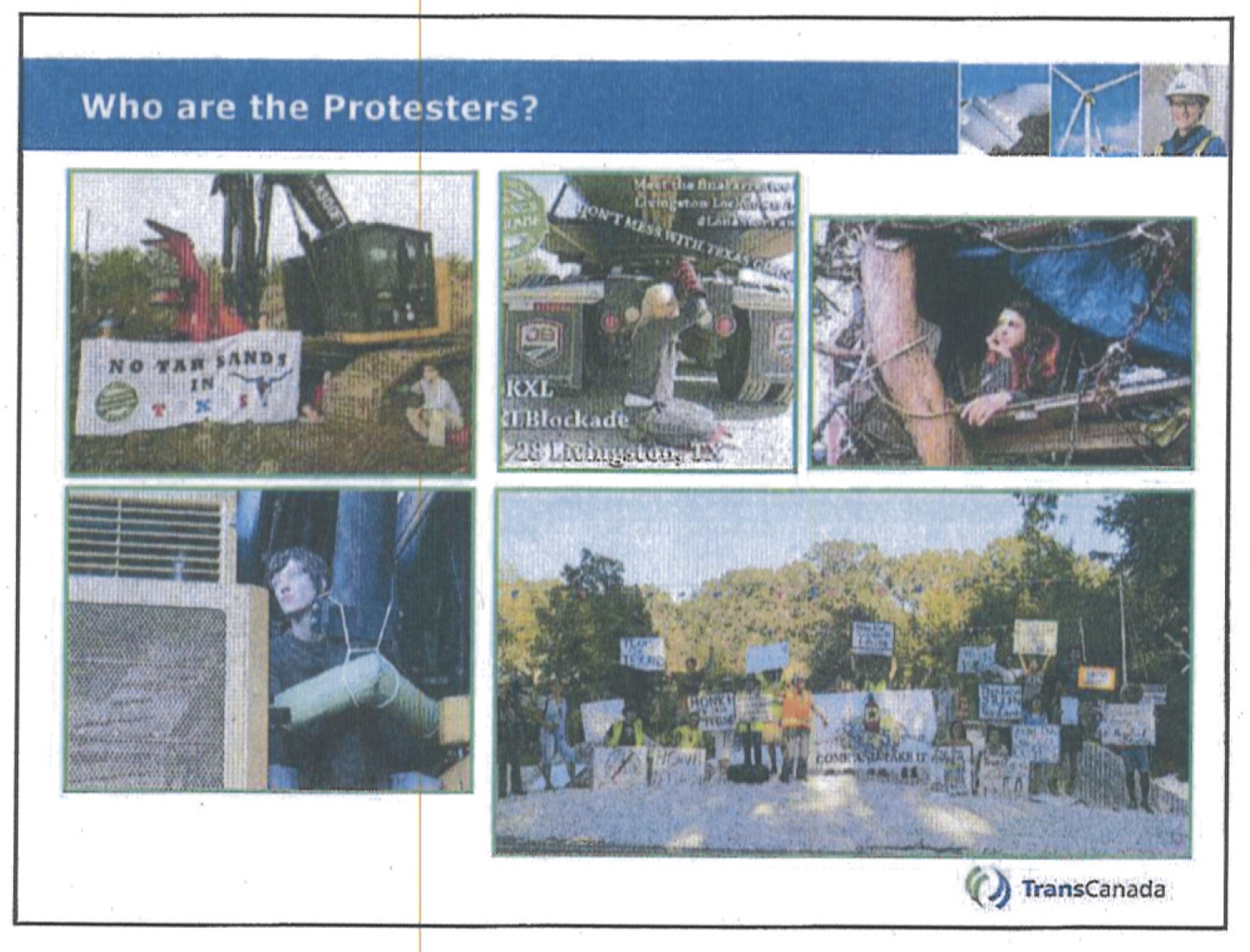
“They may climb and occupy trees"
What have protesters done that is so troubling to TransCanada that they need to beg law enforcement for assistance?“They may climb and occupy trees,” TransCanada warns.
In Oklahoma, ”a protester walked in to the lane of a slow moving vehicle.” There has been “no physical violence to this point.”
In Texas, there has been “demonstrations / protest activity,” “tree houses,” “banners,” “social media organization,” and again — no physical violence.
In Nebraska, where this briefing took place, there has been “protest/demonstrations” and “opposition attendance” at public meetings. At the very worst, landowners have allegedly been heard saying they “longed for the days when you could shoot people on your land.” However, there has not been any property destruction in the state, let alone violence.
“Try as TransCanada might to slanderize Tar Sands Blockade and our growing grassroots movement, we know who the real criminals are,” said Ron Seifert, a spokesperson with Tar Sands Blockade who was pictured in the slideshow. “The real criminals are those profiting from this deadly pipeline by endangering families living along the route and pumping illegal levels of air toxins into fence-line communities.”
Terrorism Prosecutions
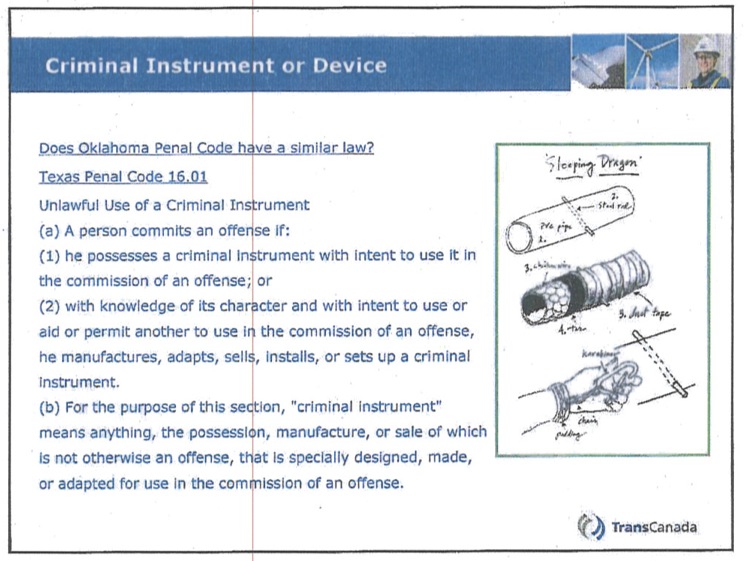 What’s
particularly troubling about this presentation is that a corporation is
briefing law enforcement about who, when, why, and how they should prosecute.
TransCanada offers police a playbook on how to go after activists. The company suggests prosecuting using criminal trespass, criminal conspiracy, criminal instrument or device (the PVC pipe used for non-violent civil disobedience), grand juries, and “federal/state anti-terrorism statues [sic].”
This isn’t empty rhetoric. In Texas, a terrorism investigation entrapped activists for using similar civil disobedience tactics. And as I reported recently for VICE, Oregon considered legislation to criminalize tree sits.
TransCanada has been using similar tactics in its home country as well (for a detailed look: “7 Ways Canadian Environmental Groups Are Being Attacked as Terrorists”).
In addition to briefing law enforcement, TransCanada is also hiring off-duty cops. In a brazen conflict of interest, local police are being paid extra cash during their off hours by the same corporation that is asking them to arrest protesters while they are on the job.
The Real Threat
One of the final slides of the presentation is particularly revealing in terms of what is at stake here. The list of “Potential Security Concerns” includesNotice the emphasis on media and public exposure? TransCanada is not pleading with law enforcement to crack down on property destruction or violence, because that’s not what this campaign is about. The campaign against the Keystone XL pipeline has resulted in widespread public support, and positive media coverage about people willing to non-violently put their bodies on the line.
- Gulf Coast Project — recent media attention.
- Keystone XL — media, high profile.
- Environmental Activism.
- Energy Action Coalition — “Fossil Fools Day”
- Protest, Blockade, Threats, Office occupation
- Future open houses, public meetings
- Landowner court challenges
That’s why TransCanada has also hired a new PR agent: the corporation says “we have been dwarfed by the content the activists have and are posting online with respect to Keystone XL.” And they say they may hire PR giant SKDKnickerbocker.
Something tells me the first recommendation from a new public relations firm will be “don’t create any more presentations like this.”
http://www.greenisthenewred.com/blog/transcanada-police-presentation-on-protests/7094/
Thursday, June 13, 2013
Plant Trees Fix Carbon
ECO-Tours have been planting trees since the mid eighties. Hundreds of thousands of living beings are spreading their canopies and providing essential shade for a myriad of other critters and organisms. Each year they lay down another layer of carbon based storage in their tree rings, branches, roots and in the leaf litter that is slowly building up under them. When we started, it would have been hard to imagine what we would grow into, but the time keeps passing and we get stronger and more efficient as time goes by. When we started, only one person funded our work and that is myself. The only money I had available was a once per year check from my tax return which I would promptly turn into trees, buying them wholesale. Then I would ride my bicycle with a cart behind it, looking for likely prospects for planting. A great group of friends and relatives would help to plant along hedgerows, in river bottoms and on hillsides, placing each tree carefully in a spot that would be perfect for that species. Because we work with all volunteer labor and our administrative costs are provided by volunteers as well, all of our income is free to buy more tree seedlings and dirt to plant them in. As we grew, we needed to find a way to add hold time to our young sprouts, so we occasionally buy soil to plant the trees in and have over 1000 plastic pots that we use to create temporary nurseries. Through the years, we have had hundreds of visitors, each one giving of time/money or both to help get trees planted, potted up, protected from hungry critters and released from crowding tendrils of their competitors, all in the hope of creating forests where there had been none.
Many of our first trees are now taller than houses, casting much needed shade over many acres, providing habitat for billions of critters. As we mature as a group, we continue to research to find better and better ways of caring for the trees, increasing survival rates and becoming more efficient in our efforts. Our next few small cost capital expenditures are for a few pieces of hardware that will allow us to transform soils more quickly, and with less effort. The trees have a much better chance of survival if the soil is first broken and aerated. This begins the life processes upon which soil health begins. trees are only as healthy as the soils that they grow on. We are looking for donors to sponsor investment in at least one broadfork these human powered tools give all the benefits of tilling, but none of the drawbacks. Rototillers, in addition to compacting the lower half of their range tend to bounce off heavy clay soils and the stench that they spew, as well as the noise are completely at odds with our efforts to heal the planet. The broadfork is designed to break the soil open so that biological activity can begin to penetrate the earth, not turn the ground to powder. Once air and moisture can move through the soil easily, bacteria, fungi and other organisms can get a foothold and begin to flourish. Second, we are putting a call out to our supporters that we want to add some tools to our arsenal for helping to pick up more native tree seeds faster.We spend many hours each year as nut gatherers.
These uniquely designed tools afford a way to effectively harvest tree seeds that help fuel our efforts. Trees have an even better chance of survival if they are sprouted in the same place that they will eventually grow and our nut planting efforts are increasing every year. several of these tools would help us to increase our efficiency and save many hours of labor. We are also designing a container for making char. This will allow direct introduction of bio-char to soils, increasing their carbon content for centuries as well as providing habitat for sopiul organisms that help to stabilize both moisture content and moderate extremes of climate, thus easing the stresses on our plantings. Carbon sequestration can take many forms and we are always in search of the most efficient ways to undo some of the ecocide that humans have been engaged in for the last century or so. Bio-char may be new to some, so I am including one more link to help explain this amazing process by which we can enhance soil quality and inject carbon into, rather than harvest it from the Earth. Biochar
We ask everyone to give what they can to our efforts. If you cannot afford to donate, contact us anyway and we can design a custom tour that you can take in your own backyard.
Tuesday, May 28, 2013
May Showers
The protracted spring that we seem to be having in Northeast Wisconsin serves the many trees we have planted this year well. their rootlets are reestablishing themselves amongst the soils that they will call home and it gives us a chance to reflect on our efforts rather than running helter skelter around the countryside watering our newly planted trees. It seems that nature has taken an interest in out efforts.
When we see birds lighting on the branches of a newly planted tree, or the circle of shade that they cast providing an island of shade under the harsh August sun, we know we are on the right track with our efforts. As with most not-for-profit organizations, we have had a downturn in donations over the past six years or so, but we expect that to change as more and more people become aware of the dire straights that the planet is in. Fixing carbon rather than blowing more into the atmosphere will have to become an art, a science and a way of life that we all take pride in if we are to stop global climate change.
a dear friend David Yarrow has You tube videos about introducing bio-char to garden soils and his results as well as my own confirm that harvests can be enhanced greatly by this simple addition to our garden beds. Here at ECO-Tours, we always remain humble knowing that there is more biomass in a cubic yard of healthy topsoil than in a whole human body. The amoeba, protozoa, algae and bacteria may be small, but these essential life creating elements are the true basis of our recovery, if there is to be one. Those motivated by corporate greed have little to no concern about the plethora of organisms upon which their lives depend, but with a bit of education and a learned sensitivity to the way things actually are, perhaps they can have their minds changed about what the responsibilities of living at the top of the food chain really are.
Shepherding, or facilitating life into niches that are conducive to growth is our specialty here at ECO-Tours and the same is true about our introduction of ideas into the public consciousness. Just as there is no room for violence in the realm of love, there can be no life in the face of the destructive forces that we unleash on the planet. Only sickness and death can result from poisoning the very ground that is meant to support us. Research has shown that the health of people is reflected in the health of the soils that their food is grown on. Surprise, surprise. Learn what the soils are in need of and you will know what to do to leave behind a better world in your wake. Start from a series of hints and work your way toward fully knowing what the Earth needs. Hint #1.) burning fossil fuels of all types leaves a toxic legacy. Hint #2.) There has never been a transportation device more efficient than a bicycle. Hint #3.) Energy, like matter cannot be created or destroyed, (this is like the giant swinging tail of the dragon) only transformed.
We have perturbed the entire envelope that is supposed to contain and constrain life on Earth as we know it. Let us all begin to act more responsibly.
Subscribe to:
Posts (Atom)